Two words, used everywhere, often meant to sound the same. Multichannel. Omnichannel.
They’re not the same. And the difference matters more than the spelling suggests.
If your business sells through more than one channel, how you manage those orders shapes everything downstream. Stock accuracy. Delivery speed. Customer experience.
This guide clears up the confusion. What order management is, what each term really means, and which approach fits where.
What Is Order Management?
Order management is how a business handles an order from the moment it’s placed to the moment it’s fulfilled.
It sounds simple. In practice, it covers a lot.
Receiving the order. Checking stock. Allocating inventory. Picking and packing. Arranging delivery. Confirming completion. And updating every record along the way.
When this runs smoothly, orders flow without friction. When it doesn’t, the cracks show up fast – as delays, errors, and unhappy customers.
The Order Fulfillment Process, in Brief
Fulfillment is the engine room of order management.
The order fulfillment process is the sequence that turns a placed order into a delivered one. It typically runs like this.
Order captured. The order enters the system from whichever channel it came through.
Stock checked. Availability is confirmed and inventory is allocated.
Order picked and packed. The goods are prepared for dispatch.
Order shipped. The order leaves for its destination.
Order delivered. The goods arrive and completion is recorded.
Every channel you sell through feeds into this same process. That’s where the question of multichannel versus omnichannel begins.
What Is Multichannel Order Management?
Multichannel means selling through many channels.
A physical store. An online shop. A marketplace. A distributor network. Each is a separate route to the customer.
Multichannel order management handles orders across all of them. But here’s the defining trait: each channel tends to operate on its own.
The online shop has its own stock view. The store has another. The marketplace tracks separately again. Orders are managed per channel, in parallel.
It works. But it creates a familiar risk. When channels don’t share a single source of truth, stock can be sold twice, records drift apart, and reconciliation becomes a manual chore.
More channels, more places for things to slip.
What Is Omnichannel Order Management?
Omnichannel also means selling through many channels. The difference is how they’re connected.
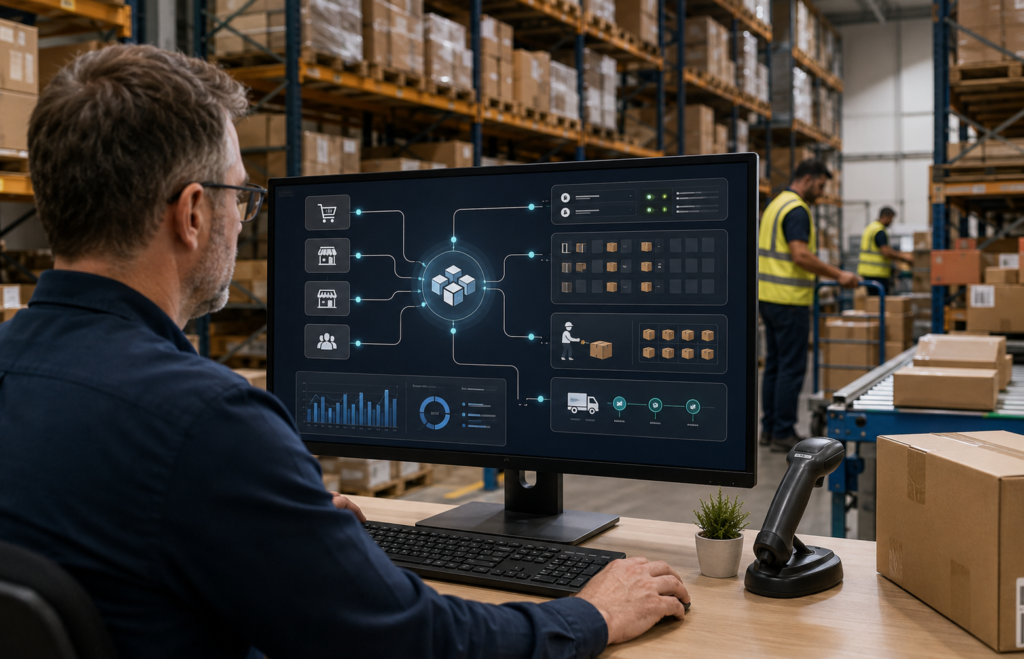
In an omnichannel approach, the channels aren’t separate islands. They share one connected view of orders and inventory.
Stock is tracked in one place, across every channel. An order from any source draws on the same live inventory. What sells in one channel is instantly reflected everywhere else.
The result is consistency. No double-selling. No conflicting stock counts. No manual stitching-together of separate systems.
Multichannel is about being present on many channels. Omnichannel is about connecting them into one.
The Key Difference, Simply Put
Think of it this way.
Multichannel puts your products in many places. Each place runs its own race.
Omnichannel puts your products in many places too. But they all run on one connected system.
The customer often can’t see the difference directly. What they feel is the result. With omnichannel, stock is accurate, orders are consistent, and fulfillment is reliable, no matter where they buy.
Behind the scenes, that consistency comes from connection.
Why This Matters for E-Commerce Fulfillment
E-commerce raises the stakes.
Online customers expect accurate stock and quick, reliable delivery. A product that shows as available but isn’t erodes trust in a single click.
When e-commerce fulfillment runs on disconnected channels, mismatches are almost inevitable. Stock sold online might already be gone from a store. Inventory counts lag behind reality.
A connected, omnichannel approach closes that gap. One live view of stock means what customers see is what you actually have. Orders flow to fulfillment cleanly, wherever they originate.
For businesses selling online alongside other channels, this is the difference between growth and constant firefighting.
Which Approach Is Right for You?
There’s no single answer. It depends on where your business is.
A business selling through one or two simple channels may manage well enough with a multichannel setup.
But as channels multiply, and as e-commerce grows, the cost of disconnection rises. More channels mean more chances for stock errors and more manual work to keep everything aligned.
At that point, connecting your channels stops being a nice-to-have. It becomes the foundation of reliable fulfillment.
The direction of travel is clear. As selling gets more complex, connected wins.
Bringing Your Channels Together
The terminology can be confusing. The underlying idea is not.
Selling across many channels is powerful. Managing them as one connected system is what makes that power sustainable.
Simplr’s Multi-Channel Order Management solution helps businesses bring their orders and inventory into a single connected view, so stock stays accurate and fulfillment stays reliable across every channel.
Many channels. One source of truth.
That’s how modern order management should feel.
Schedule a free consultation to learn more!
Solutions Deployed
Warehouse Management System
Implemented a Warehouse Management System to automate and optimize warehouse operations, from receiving and put-away to picking, packing, and shipping.