
Future of Warehousing: AI-Powered Mobility WMS 2.0
- 21 October 2026 , Wednesday
- 3:00 PM SGT
Future of Warehousing: AI-Powered Mobility WMS 2.0
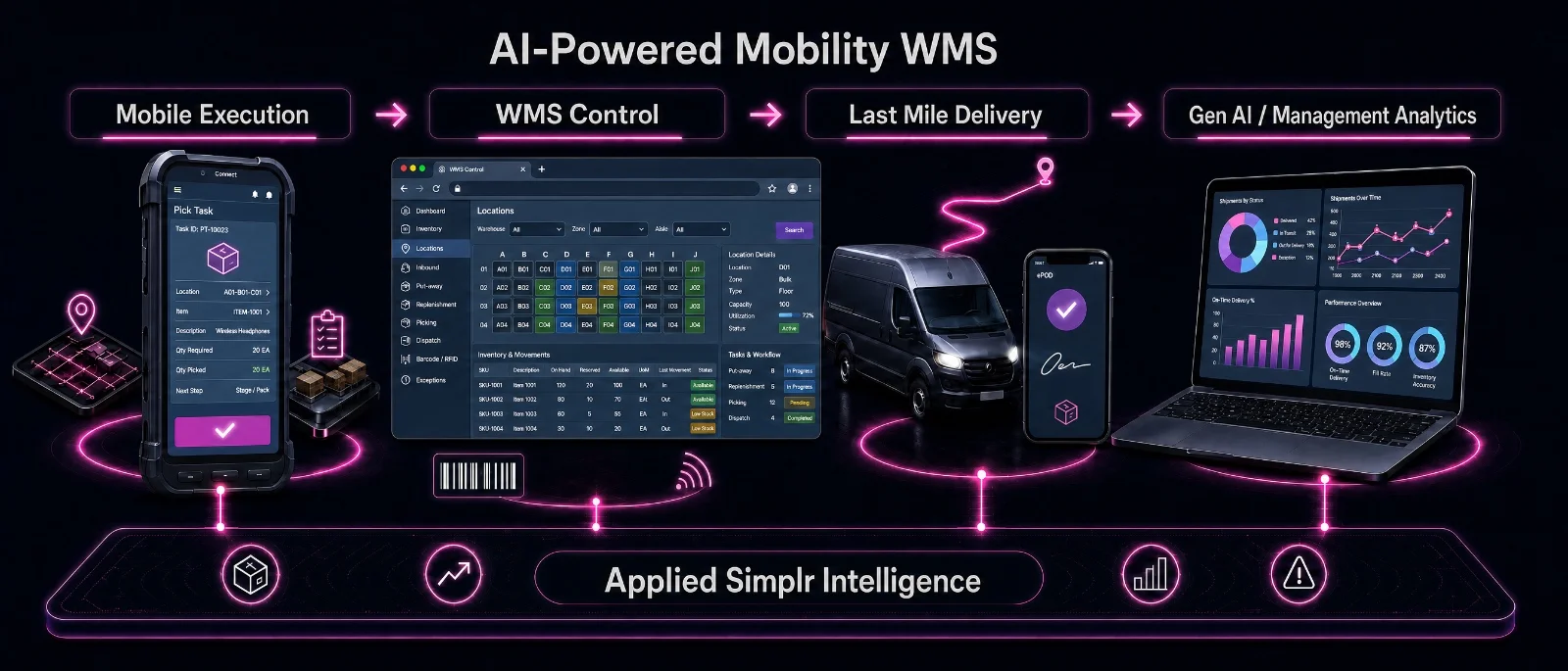
See how AI-Powered Mobility WMS 2.0 connects mobile warehouse execution, real-time inventory control, barcode/RFID traceability, AI forecasting, and management analytics—from receiving through to dispatch.
The future warehouse is not just automated. It is intelligent at the point of work.
Warehouses do not improve because they add another screen. They improve when every scan, task, movement, and exception becomes an accurate signal available to the warehouse user in the aisle and to the supervisor making the next decision.
AI-Powered Mobility WMS 2.0 brings the warehouse floor, the control layer, and the management view together. It helps teams execute the right task on a mobile device, maintain real-time visibility of inventory and movement, anticipate what may need attention next, and turn operational data into useful management insight.
| From a traditional warehouse model | To AI-Powered Mobility WMS 2.0 |
|---|---|
| Paper, delayed updates, and disconnected handoffs | Mobile tasks and scan-led updates at the point of work |
| Inventory information that is difficult to trust in the moment | Real-time visibility across locations, movements, and warehouse activity |
| Supervisors spending time finding and reconciling issues | Exception and priority signals to guide action where it matters most |
Every scan creates data. Intelligence turns it into action.
From warehouse activity to warehouse intelligence
The WMS 2.0 operating model
See the connected warehouse flow: Receive → put away → replenish → pick → pack/load → dispatch. Understand where control, mobility, and intelligence matter at each stage.
Mobile execution that works on the warehouse floor
Explore task-led mobile workflows for receiving, put-away, picking, transfers, stock take, replenishment, and loading including offline capability where connectivity is limited.
Inventory control and traceability in real time
See how item groups, locations, batches/lots, journal history, and barcode/RFID capture can provide a more reliable view of inventory movement and status.
AI-assisted operational decisions
Understand practical areas where intelligence can support warehouse teams: replenishment signals, task priority, exception visibility, and decision support for supervisors.
Forecast, analyse, and act ahead
Explore how AI forecasting and management analytics turn warehouse, order, and inventory data into forward-looking signals, operational dashboards, and more informed planning decisions.
The AI-Powered Mobility WMS 2.0 difference
| WMS 2.0 value layer | What it does | Why it matters |
|---|---|---|
| Mobile execution | Gives warehouse users guided tasks, scanning capability, and live workflow updates at the point of activity. | Helps teams act faster and more consistently on the warehouse floor. |
| WMS control | Maintains inventory, locations, movements, rules, traceability, and warehouse workflow discipline. | Gives supervisors a dependable operational picture and connects warehouse activity with ERP, delivery, ePOD, and upstream order channels. |
| Applied intelligence | Surfaces task priorities, replenishment needs, and exceptions that require attention. | Helps people make better decisions without overstating automation. |
| Forecasting & Gen AI management analytics | Combines historic movement, demand patterns, inventory position, productivity, and exception data into forward-looking replenishment signals and usable management dashboards. | Helps teams anticipate needs, monitor performance, identify bottlenecks, and take better-informed operational action. |
What you will take away
| Takeaway | What you will gain |
|---|---|
| A practical WMS 2.0 framework | A clear view of the operating flow that connects receiving, storage, replenishment, picking, dispatch, and exceptions. |
| A frontline mobility perspective | An understanding of how mobile tasks, scanning, offline capability, and real-time updates support the people who run the warehouse. |
| A grounded view of warehouse intelligence | Clarity on how AI forecasting, replenishment signals, and management analytics can support decisions today—and what remains dependent on process, rules, data, and human judgement. |
| A connected-fulfilment perspective | Insight into how WMS can connect to ERP, upstream orders, barcode/RFID, delivery, ePOD, and management analytics. |
Who should attend
| Role | Why This Session Is Relevant |
|---|---|
| Warehouse Managers & Fulfilment Heads | Explore execution control, inventory visibility, mobile tasks, and productivity opportunities. |
| Operations & Supply Chain Leaders | Understand how WMS 2.0 can support service levels, fulfilment discipline, and operational decision-making. |
| IT & Digital Transformation Leaders | Review mobile architecture, barcode/RFID, integration, data, and workflow considerations behind a modern WMS. |
| Distribution & Logistics Leaders | See how warehouse activity can connect with order flow, delivery, ePOD, and wider supply-chain operations. |
| Business Owners & General Managers | Assess whether a practical, mobile-first WMS can support scale, control, and better visibility in the warehouse. |
Why This Session Is Different
- A warehouse workflow—not a feature tour
The session follows the working reality of receiving, storage, replenishment, picking, and dispatch, so the audience sees how the pieces connect. - Mobile execution at the centre
The focus is on the people who receive, scan, move, pick, and load stock—not just the screens viewed from an office. - AI explained with operational context
We will show where intelligence can help guide replenishment, priorities, and exceptions, without confusing AI claims with core WMS controls. - Real warehouse perspective
The session draws on Simplr’s established Mobility WMS proposition and warehouse implementation experience, with time reserved for your specific questions.
Your 50-minute session
| Time | Segment | Focus |
|---|---|---|
| 00:00–00:05 | Welcome and the WMS 2.0 promise | The shift from warehouse activity to connected, intelligence-led execution. |
| 00:05–00:12 | Why traditional warehouse processes reach a limit | Delayed data, paper handoffs, workforce pressure, visibility gaps, and fulfilment accuracy. |
| 00:12–00:20 | The connected warehouse operating flow | Receive → put away → replenish → pick → pack/load → dispatch. |
| 00:20–00:32 | Mobility WMS walkthrough | Mobile warehouse tasks, barcode/RFID, real-time inventory, control points, and offline operation. |
| 00:32–00:40 | Simplr Intelligence in the warehouse | AI forecasting, replenishment signals, task priorities, operational exceptions, and management analytics dashboards. |
| 00:40–00:45 | Warehouse proof and connected fulfilment | WS Audiology example; ERP, delivery/ePOD, upstream order channels, and the connected fulfilment view. |
| 00:45–00:50 | Q&A | Questions with Ramas and CJ. |
Speaker Bio


Ramas
Co-Founder | Director – Simplr Solutions
Mr. Ramas is a seasoned entrepreneur with over 25 years of expertise in business strategy, enterprise solutions, and digital transformation. With a deep understanding of enterprise mobility, distribution, and warehouse management, he has played a pivotal role in shaping industry-leading solutions. His leadership has been instrumental in driving innovation, optimising business processes, and delivering scalable technology solutions across diverse industries. As a visionary in enterprise solutions, he continues to spearhead advancements in digital transformation and operational efficiency.

CJ Ong
Sales Director, Malaysia
Register for Free
Fill in your details below to reserve your spot!
Can’t join live on 21 October?
Register now to receive the on-demand recording and a concise session summary after the webinar.
Details
- 21 October 2026, Wednesday
- 3:00 PM SGT
- 45 minutes + 5-minute Q&A
- Mr. Ramas B, Co-Founder & Director, Simplr Solutions
- CJ Ong, Sales Director - Malaysia
- Online (Zoom)
Unable to join live? Register to receive the on-demand recording.